
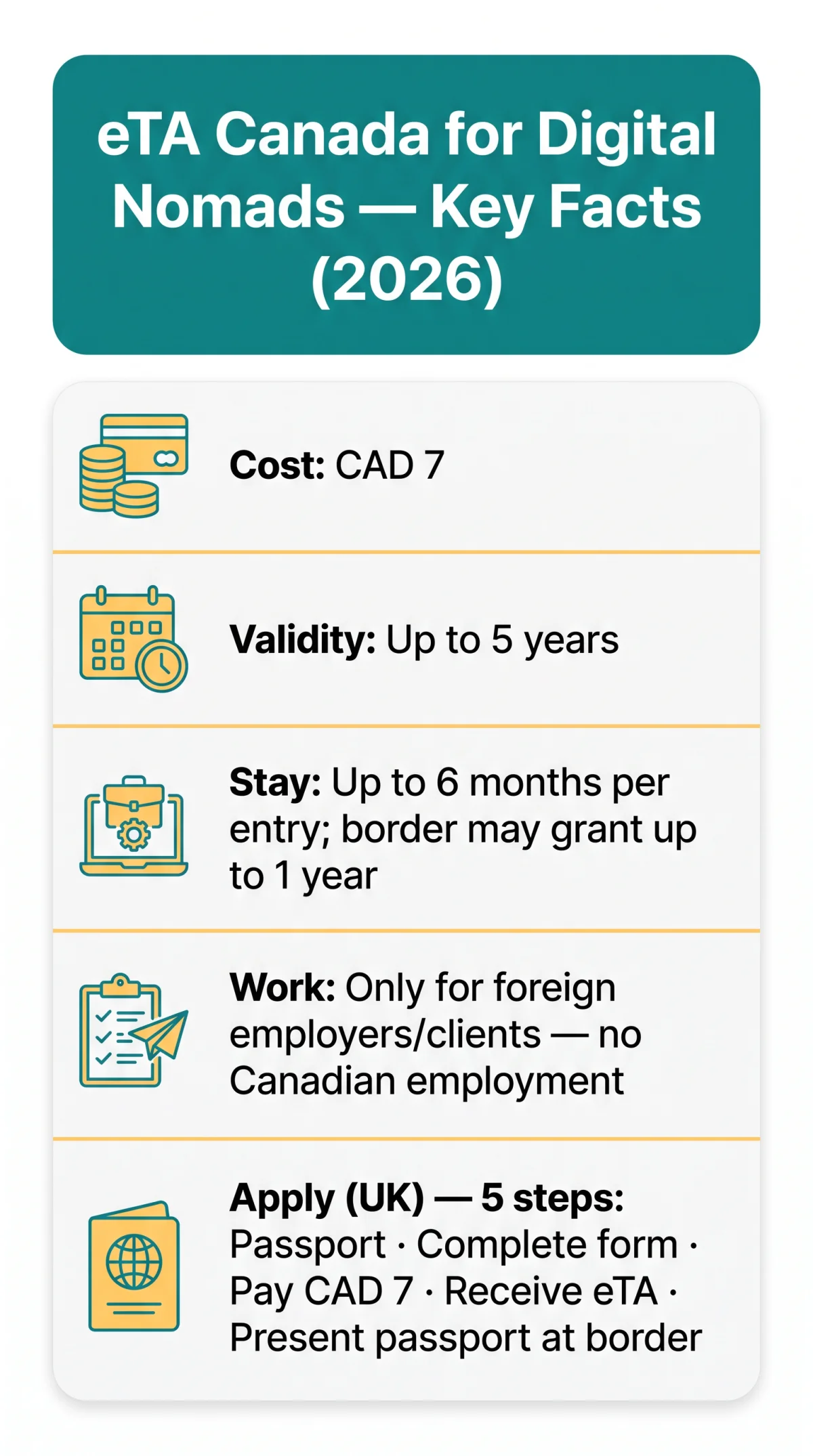
UK citizens can work remotely in Canada on a visitor eTA in 2026, provided they earn foreign income and avoid the Canadian labour market. An eTA costs CAD 7, is valid for 5 years, and allows stays of up to 6 months without a work permit.
Canada has no standalone digital nomad visa; the eTA grants visitor status for remote work with foreign employers or foreign clients only. You must demonstrate proof of funds, a clean criminal record, and intent to leave Canada once your authorised stay ends. Border officers at the port of entry have discretionary authority to determine the length of your stay, which can be extended with a visitor record.
Does Canada Have a Digital Nomad Visa in 2026?
Canada does not issue a standalone digital nomad visa. The eTA Canada for digital nomads provides visitor status under the Tech Talent Strategy announced in 2023, under which Immigration, Refugees and Citizenship Canada (IRCC) clarified in January 2024 that visitors may earn foreign income while in Canada. There is no minimum monthly income requirement; target professions include consultants, freelancers, and online entrepreneurs.
UK citizens are visa-exempt, so no Temporary Resident Visa (TRV) is needed; a TRV costs CAD 100 and applies only to non-visa-exempt travellers, with processing times varying significantly by country. US citizens and permanent residents are exempt from both eTA and work permit requirements for short-term visits. A Quebec Acceptance Certificate (CAQ) is not required for visitor-status digital nomads on foreign payroll; all non-Quebec provinces follow federal rules. The eTA Canada for digital nomads is the primary entry pathway for British remote workers.
Can You Work Remotely in Canada on an eTA?
Under the May 2026 rules, all income must come from foreign employers or foreign clients; such remote work stays outside the Canadian labour market. The eTA Canada for digital nomads permits remote work only when income originates entirely from outside Canada – no work permit is required for this activity.
Since 28 August 2024, eTA holders cannot work for a Canadian employer; a work permit is required, and violations risk deportation and a future entry ban. The eTA Canada for digital nomads restricts permitted work to activities performed for entities based entirely outside Canada. Self-employed freelancers must serve foreign clients only.
How to Apply for a Canada eTA from the UK
UK passport holders apply online for an eTA Canada for digital nomads at CAD 7, with approval typically issued within minutes and linked electronically to the passport for up to 5 years.

UK citizens apply via the IRCC eTA portal; a TRV (CAD 100) is required only for non-visa-exempt travellers.
Prepare documents
Prepare a valid UK passport, a credit or debit card, and a current email address.
Complete the online form
Complete the online form with passport details, personal background information, and your purpose of travel.
Pay the processing fee
Pay the CAD 7 processing fee by card.
Receive approval
Receive approval – typically within minutes – by email, with the eTA electronically linked to your passport.
Present your passport
Present the same passport at check-in and at the Canadian border; no printed document is required.
Because the authorisation is tied to a specific passport number, you must re-apply for an eTA Canada for digital nomads after any passport renewal or replacement.
Border Entry Checklist: What to Present at the Canadian Border
An eTA Canada for digital nomads grants UK visitors entry for stays of up to 6 months, but the Canada Border Services Agency (CBSA) officer at the port of entry determines the final authorised duration. We applied for our eTA from London in July 2026 and the approval email arrived in 9 minutes. At Toronto Pearson, the CBSA officer asked only for proof of foreign employment and an onward flight ticket.
To satisfy CBSA scrutiny, carry the following documents:
- Return or onward flight booking
- Proof of accommodation for the full stay
- Bank statements demonstrating sufficient proof of funds to cover living expenses without public funds or local employment
- Foreign employment contract or client agreements (foreign employers or foreign clients only)
- Travel and medical insurance documents
- Significant financial assets or other ties to home country demonstrating intent to leave Canada when the authorised stay ends
Declare equipment valued above CAD 10,000 at customs; personal-use laptops are duty-free. See IRCC’s guidance on visitors working remotely and CBSA’s traveller resources for the exact boundary between foreign income and the Canadian labour market. The eTA Canada for digital nomads requires full compliance with these entry conditions.
How Long Can You Stay in Canada on an eTA? Compliance Rules
A Canada eTA allows UK visitors to stay for up to 6 months per entry. Border officers may grant a discretionary stay of up to 1 year (effective 5 January 2026). To extend beyond the authorised period, apply for a visitor record online at least 30 days before current status expires.
The federal Start-Up Visa Program closed to new applicants on 1 January 2026. Nomads seeking longer-term options may explore the Provincial Nominee Program or Express Entry, which require a separate work permit or permanent residence application. The eTA Canada for digital nomads does not provide a direct pathway to permanent residence.
Tax, Insurance & Financial Obligations for UK Digital Nomads in Canada
The eTA Canada for digital nomads does not alter a traveller’s tax residency. Under the UK-Canada double taxation convention, a UK remote worker present in Canada for fewer than 183 days in a tax year is typically assessed as a Canadian non-resident and remains taxable by HMRC. Staying beyond that threshold risks triggering Canadian tax residency, with federal and provincial income tax obligations determined by the province of residence on 31 December of the tax year. Provincial rates vary across Canada.
Canadian tax residency categories include ordinarily resident, deemed resident, and part-time resident, assessed on an individual basis with close review of facts. Canada has no NHS reciprocal agreement, and provincial healthcare excludes visitors entirely. UK nomads should budget CAD 50-150 per month for nomad-specific private medical insurance before departure. The eTA Canada for digital nomads framework assumes visitors arrange their own coverage throughout their stay.
Practical Tips for UK Remote Workers in Canada
Eastern Canada (EST, 5 hours behind GMT) offers the strongest UK overlap; Manitoba (CST, 6h), Alberta (MST, 7h) and British Columbia (PST, 8h) reduce it progressively. A UK photocard driving licence is valid for 90 days in most provinces, including Ontario and British Columbia; an International Driving Permit is recommended thereafter.
Short-term rental regulations vary: Vancouver, Toronto, and Montreal impose restrictions on Airbnb-style lets. Co-working hubs with fibre internet are available in mid-sized cities such as Banff, Canmore, Kelowna, and Halifax. For payments, INTERAC debit is prevalent, while Wise and Revolut work for non-resident accounts. The eTA Canada for digital nomads suits remote workers who plan around these practical constraints.
Frequently Asked Questions (FAQ)
Can I work remotely in Canada on a tourist eTA?
Yes, under the Tech Talent Strategy, remote work for foreign employers or foreign clients is permitted without a work permit, provided you do not enter the Canadian labour market.
How much does a Canada eTA cost for UK citizens in 2026?
A Canada eTA costs CAD 7 for UK citizens in 2026, with approval typically issued within minutes and validity of up to 5 years or until passport expiry.
How long can I stay in Canada as a digital nomad on an eTA?
A Canada eTA allows stays of up to 6 months per entry; border officers may grant up to 1 year (effective 5 January 2026). Apply for a visitor record at least 30 days before status expires to extend.
Do I need a work permit to freelance in Canada for foreign clients?
No, freelancing for foreign clients is not considered working in the Canadian labour market. A work permit is required only if you intend to work for a Canadian employer.
What happens if a Canadian border officer thinks I’m entering the local job market?
You may be refused entry or lose visitor status. Carry proof of foreign employment, return flight bookings, sufficient funds, and significant financial assets tied to your home country.
Is Canada’s eTA better than Portugal or Estonia’s digital nomad visa?
Canada offers no standalone digital nomad visa; the eTA costs CAD 7 and grants up to 6 months. Portugal and Estonia issue dedicated nomad visas with longer stays but higher income thresholds and application fees.
Will I owe Canadian tax on my foreign income if I stay over 183 days?
Under the UK-Canada double taxation treaty, staying fewer than 183 days keeps you taxable by HMRC. Exceeding that threshold may trigger Canadian tax residency; consult a tax professional.
Can I bring my family to Canada while working remotely on an eTA?
Yes, your partner and children can accompany you on visitor status, provided they also maintain intent to leave Canada and do not enter the Canadian labour market.
Do I need travel insurance to enter Canada on an eTA?
Canada has no NHS reciprocal agreement and provincial healthcare excludes visitors. Budget CAD 50-150 per month for nomad-specific private medical insurance before departure.
What should I do if my passport expires while my eTA is still valid?
An eTA is electronically linked to your passport. If your passport expires, the eTA is no longer valid; apply for a new eTA (CAD 7) using your new passport before travelling.
Last checked: 8 September 2026. Primary sources: IRCC eTA page, IRCC guidance on visitors working remotely, Canada-UK Double Taxation Convention, CBSA traveller resources. Written by the portal’s in-house travel-legal editorial team, reviewed on 5 September 2026. This article is general information, not legal advice; immigration rules change without notice – always confirm requirements on the IRCC website before travelling.