

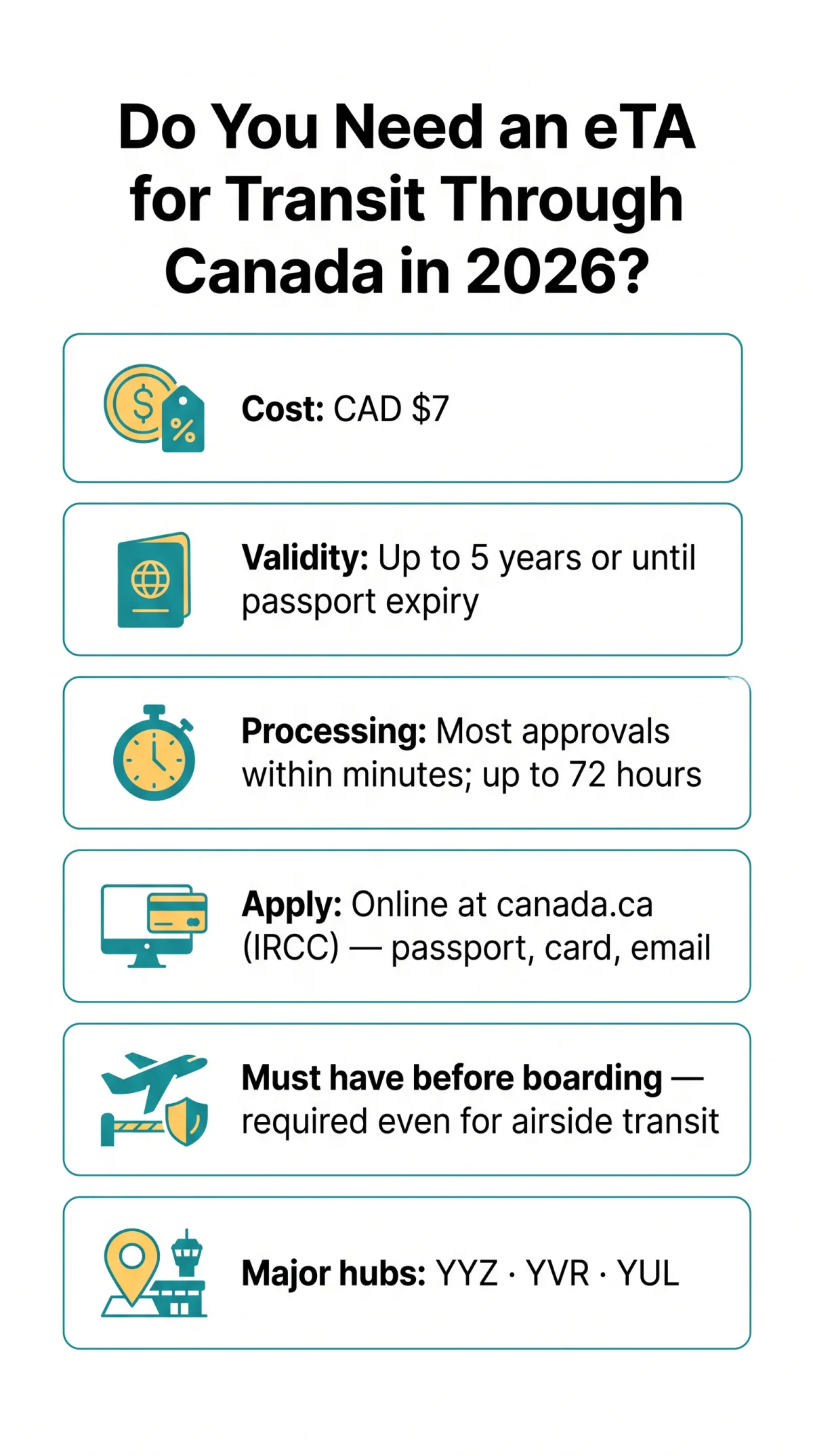
Yes. If you are flying through a Canadian airport, even for a connecting flight without leaving the terminal, you need a valid Electronic Travel Authorization (eTA) before boarding. UK citizens can apply online for CAD $7, and the eTA remains valid for up to five years or until passport expiry.
British citizens are visa-exempt foreign nationals, so the eTA applies to any Canadian layover at Toronto Pearson (YYZ), Vancouver (YVR), or Montreal-Trudeau (YUL). It is linked electronically to your passport and must be obtained before you travel. The eTA is mandatory whether you remain in the sterile transit zone or clear CBSA to collect checked baggage.
What Is a Canadian eTA and Who Needs It for Transit?
Every visa-exempt foreign national flying to or through Canada by air must hold a valid eTA before boarding. The eTA applies exclusively to air travel – arrivals by land, sea, or rail do not trigger this obligation. British citizens travelling on a full “British citizen” passport are visa-exempt, so eTA Canada transit requirements apply to any itinerary including a Canadian airport layover.
The application costs CAD $7, is valid for up to 5 years or until the passport expires (whichever comes first), and most approvals arrive within minutes; complex cases can take up to 72 hours. Travellers can apply online via the IRCC eTA application portal. An approved eTA does not guarantee entry – a border services officer makes the final decision at the port of entry.
10 Nov 2016
eTA in force for visa-exempt nationals
1 Dec 2016
Mexico citizens subject to eTA
1 May 2017
Brazil citizens subject to eTA
1 Dec 2017
Bulgaria and Romania subject to eTA
Who Is Exempt from the eTA Requirement When Transiting Through Canada?
Several categories of travellers are exempt from eTA Canada transit requirements. U.S. citizens are exempt for air, land, and sea travel – they need only proper identification such as a valid U.S. passport. Canadian dual citizens cannot apply for an eTA and must present a valid Canadian passport. British-Canadian dual nationals also do not need an eTA and must use a valid Canadian passport.
U.S. Green Card holders (lawful permanent residents) must obtain an eTA when flying to or through Canada and carry their permanent resident card, but are exempt when entering by land or sea directly from the U.S. Holders of a valid Canadian visa or permit are exempt. Visa-required travellers, including alien’s passport holders and stateless individuals, are ineligible for an eTA. eTA Canada transit requirements do not apply to Transit Without Visa (TWOV) or China Transit Program participants, though these do not apply to UK citizens.
eTA vs Transit Visa – Which One Do You Need?
UK citizens flying through a Canadian airport need an eTA, not a transit visa – transit visas apply only to nationals of non-visa-exempt countries. eTA Canada transit requirements clarify that the eTA and a temporary resident visa (TRV) are distinct documents and are never required simultaneously.
| Attribute | eTA | Transit Visa |
|---|---|---|
| Who qualifies | Visa-exempt nationals (incl. UK) | Non-visa-exempt nationals |
| Cost | CAD $7 | Varies (check IRCC) |
| Processing time | Within minutes (most applicants) | Days to weeks |
| Validity | Up to 5 years or until passport expires | Single or multiple entry |
| Application method | Online via IRCC portal | Embassy or consulate |
| Travel modes covered | Air only | Air only |
Decision flow: Visa-exempt country (UK = yes) → eTA. Non-visa-exempt country → transit visa, or check Transit Without Visa (TWOV) / China Transit Program eligibility. The TWOV and China Transit Program do not apply to UK citizens. eTA Canada transit requirements apply only to air travel.
Air Transit vs Land and Sea – What Changes for eTA?
eTA Canada transit requirements apply exclusively to air travel. Travellers arriving by land (car, bus, train) or sea (cruise ship, ferry) do not need an eTA, regardless of nationality. However, airside transit – staying within the international sterile zone – still requires an eTA to board the inbound flight to Canada.
Landside transit, such as leaving the sterile area to change terminals, retrieve luggage, or stay overnight, requires an eTA and triggers CBSA border clearance. For example, taking a cruise that docks in Halifax requires no eTA, but flying London to Cancún via Toronto does. eTA Canada transit requirements are triggered the moment you board a flight to a Canadian airport.
Step-by-Step: What Happens When You Transit Through a Canadian Airport
All transit passengers arriving by air must clear Canada Border Services Agency (CBSA) upon landing, even when connecting to another international flight. eTA Canada transit requirements determine your eligibility at each stage.
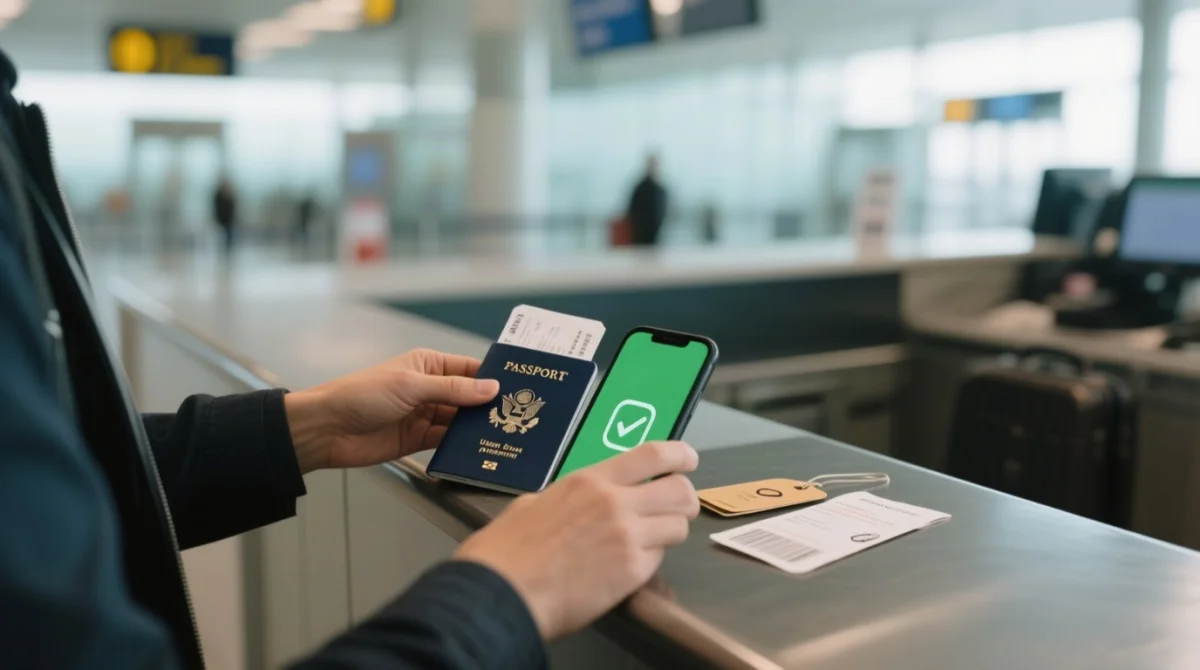
Here is what happens at every stage of your journey through a Canadian airport:
Before departure
Airline staff scan your passport to verify a valid eTA electronically. A mismatched passport number means you cannot board.
Arrival in Canada
CBSA processes you at your first port of entry. Present your eTA-linked passport and onward boarding pass; a border services officer verifies eligibility.
Baggage
On a single ticket, bags transfer automatically to your connecting flight. On separate tickets, you must clear customs, collect bags, and re-check them.
Connecting flight
Proceed to your departure gate. Terminal changes (e.g., Toronto Pearson T1 to T3) may require exiting and re-entering through security.
U.S. preclearance (if applicable)
At YYZ and YVR, onward U.S. flights clear U.S. Customs and Border Protection in Canada before boarding. You need a valid eTA for the Canadian leg plus ESTA or a U.S. visa.
Major hubs: Toronto Pearson (YYZ), Vancouver (YVR), and Montreal-Trudeau (YUL) all offer U.S. preclearance facilities. eTA Canada transit requirements apply at each of these airports.
How to Apply for an eTA for Transit Through Canada
Visa-exempt British passport holders travelling by air must apply online and pay a CAD $7 fee before boarding any flight transiting through Canada. eTA Canada transit requirements are administered by Immigration, Refugees and Citizenship Canada (IRCC) via the portal at canada.ca, requiring a valid biometric passport, a credit or debit card, and an email address.
Processing takes within minutes for most applicants, though complex cases can take several days if supporting documents are requested. IRCC recommends applying before booking flights. eTA Canada transit requirements stipulate that each authorisation is linked to the passport number used, so renewing your passport means obtaining a new eTA. A friend or family member may submit the application on your behalf, but payment covers one person at a time.
To verify approval, use the IRCC eTA status tool with your passport number and date of birth. If no confirmation arrives after 72 hours, check your spam folder, verify the passport number, and submit a case-specific enquiry. Only apply through the canada.ca domain, as unofficial scam sites charge inflated fees.
Frequently Asked Questions (FAQ)
Do I need an eTA to transit through Canada on a connecting flight?
Yes. Visa-exempt foreign nationals, including UK citizens, need a valid eTA before boarding. Airline staff scan your passport at check-in; without one, you cannot board. eTA Canada transit requirements apply even if you never leave the airport.
Can I leave the airport during a layover in Canada without an eTA?
No. Leaving the sterile transit area requires clearing the Canada Border Services Agency (CBSA), which requires a valid eTA or visa.
What happens if my flight is cancelled and I must leave the transit area?
You need a valid eTA to clear Canadian border control. Contact your airline about rebooking and accommodation. Know your rights under Canada’s Air Passenger Protection Regulations.
Do I need an eTA if my flight only stops in Canada to refuel?
Technically yes. If the aircraft lands in Canadian territory, passengers arrive in Canada. Airlines typically require eTA verification even for technical stops, regardless of whether passengers remain onboard.
What if my layover is overnight? Do I need an eTA?
Yes. Canadian airport transit zones are generally not open 24 hours a day, meaning overnight layovers typically require clearing CBSA and entering Canada. This triggers the necessity for a valid eTA.
Do I need an eTA if I’m connecting through two Canadian airports, for example Montreal to Vancouver?
Yes. You must clear CBSA at your first point of entry, which is treated as formal entry rather than transit. eTA Canada transit requirements apply regardless of transit intent.
Is the eTA the same as a transit visa for Canada?
No. An eTA is for visa-exempt nationals, including UK citizens, travelling by air and costs CAD $7. A transit visa is for nationals of non-visa-exempt countries transiting airside.
How do I check my eTA status, and what should I do if I haven’t received confirmation?
Use the IRCC eTA status tool (passport number + date of birth). If no confirmation arrives after 72 hours, check spam, verify the passport number, and submit a case-specific enquiry to IRCC.
Last reviewed: 8 September 2026. This article is for guidance only and does not constitute legal advice. Our editorial team verifies facts against IRCC and GOV.UK sources. We check for policy changes every quarter.