
Last reviewed: September 2026. This article is for informational purposes only and does not constitute legal advice. For personalised guidance, consult a licensed immigration professional.
The Lonely Canadian Rule is the informal term for IRPR s. 117(1)(h), allowing a Canadian citizen or permanent resident in Canada with no qualifying relatives worldwide to sponsor one extended family member for permanent residence. UK passport holders can visit Canada on a CAD $7 eTA while sponsorship is pending, provided they manage dual intent carefully.
This provision falls under the Family Class Sponsorship category and does not itself grant an Electronic Travel Authorization (eTA). The sponsored relative must apply separately for temporary entry. Sponsorship processing takes 1 to 3 or more years, with documented favourable cases resolving in approximately 15 months. Because the rule requires the sponsor to have no close relatives anywhere in the world, strict eligibility criteria apply under the existence not closeness test.
What Is the Lonely Canadian Rule?
The Lonely Canadian Rule is the informal name for Section 117(1)(h) of the Immigration and Refugee Protection Regulations (IRPR), a Family Class Sponsorship provision that grants permanent residence – not temporary entry or eTA – to one qualifying relative of an eligible Canadian sponsor.
Immigration lawyers and practitioners coined the label to describe the “other relative” category within Family Class Sponsorship. The rule belongs to this category and is only available to a Canadian citizen or PR residing in Canada whose disqualifying relatives (spouse, child, parent, grandparent, sibling, aunt, uncle, niece, nephew) do not exist anywhere in the world. Sponsored relatives must independently qualify for an eTA or visitor visa for interim visits during the 1-3+ year processing period. IRCC publishes further details on family sponsorship on the IRCC website.
Who Can Sponsor and Who Qualifies Under the Lonely Canadian Rule?
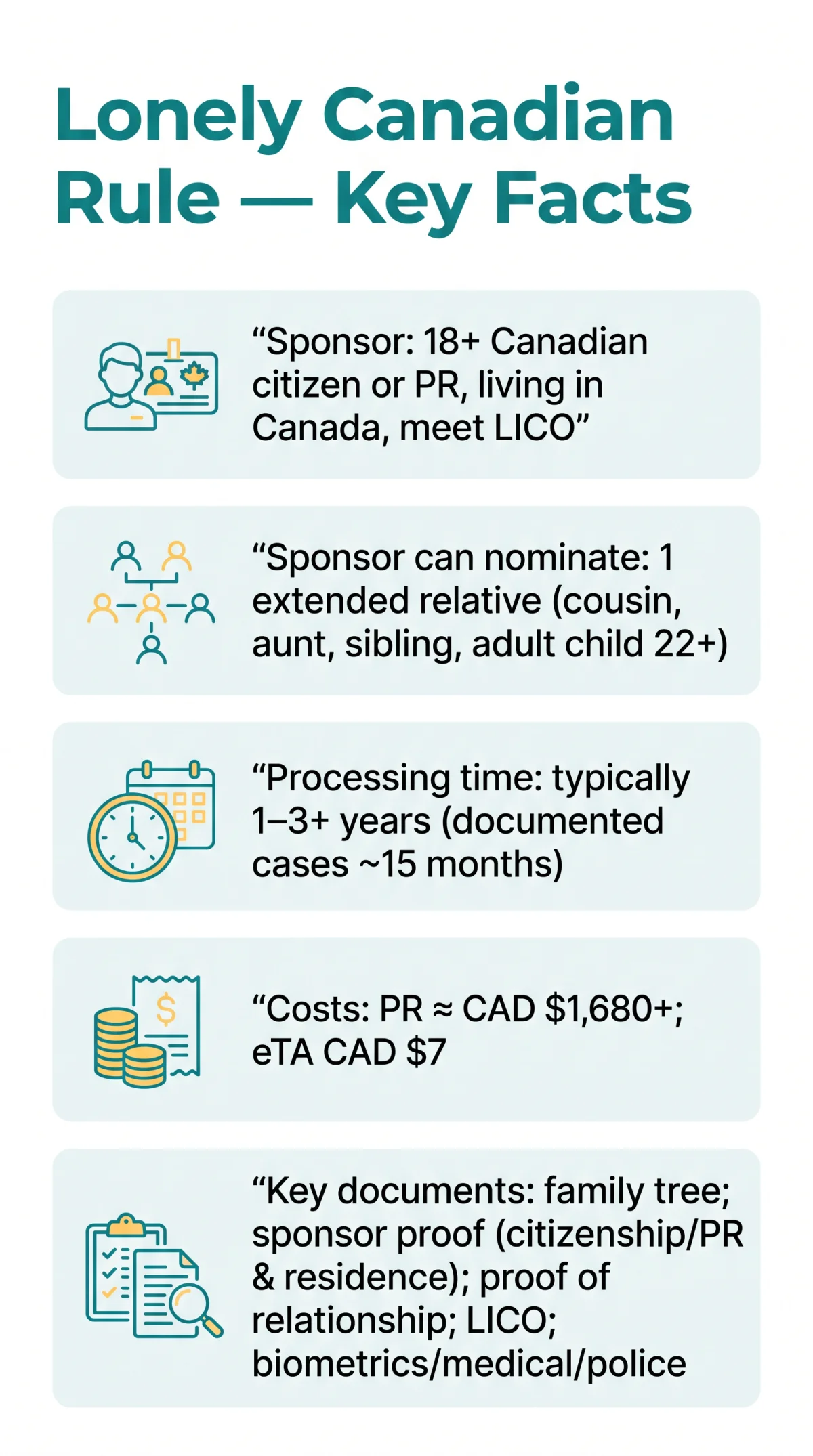
Sponsors must be 18+, Canadian citizens, permanent residents, or Registered Indians, residing in Canada, meeting Minimum Necessary Income (MNI) at Low Income Cut-Off (LICO) thresholds, with no disqualifying criminal convictions involving family members. The binding sponsorship undertaking to the Government of Canada lasts 3 years (relative 22+) or 10 years (under 22) (IRPR s. 132). The Lonely Canadian Rule permits sponsorship of one blood or adopted relative of any age, including cousins, great-aunts, great-uncles, great-nieces, great-nephews, siblings, and adult children aged 22+. Dependent children of the sponsored person may accompany them.
The Lonely Test – Proving No Close Relatives Exist Worldwide
The ‘existence not closeness’ test disqualifies a sponsor with any living spouse, partner, child, parent, grandparent, sibling, niece, nephew, aunt, or uncle anywhere – even estranged, no-contact, or medically unable to travel. A separated spouse counts unless legally divorced. A relative who is a Registered Indian under the Indian Act also counts as disqualifying Canadian status. As per IRCC operational manual IP 4, this test is strictly applied.
Who Cannot Be Sponsored Under This Rule
In-laws, step-relatives, family-by-marriage, and friends are ineligible as principal applicants under the Lonely Canadian Rule; in-laws qualify only as dependants. This differs from the Orphaned Relative Exception (IRPR s. 117(1)(f)), which covers siblings, nieces, nephews, or grandchildren under 18, unmarried, with both parents deceased, and requires no worldwide family test but still requires MNI/LICO compliance and limits to one per category.
How the Lonely Canadian Rule Affects eTA Applications for Family Members
The Lonely Canadian Rule is a permanent residence pathway and does not itself grant an eTA; UK relatives must apply separately for a CAD $7 eTA to visit during the 1-3+ year sponsorship process.
eTA vs. Visitor Visa – Choosing the Right Pathway
The rule does not waive visa requirements. UK passport holders (visa-exempt) apply for an eTA (CAD $7, minutes to 72 hours, valid up to 5 years or until passport expires, multiple entries); nationals of visa-required countries need a visitor visa (CAD $100+, weeks to months). Neither document equals the PR application. eTA refusal risk exists under IRPR s. 179(b) if requirements are not met.
Dual Intent – Visiting on eTA While Awaiting PR Sponsorship
Dual intent (IRPA s. 22(2)) is allowed, but the burden is on the applicant to prove departure. Recommended UK tie documents: employment contract, tenancy, bank statements, return bookings. Concealing a pending sponsorship risks misrepresentation under IRPA s. 40. A temporary eTA visit does not constitute “residing in Canada” under IRPR, so it should not affect the sponsor’s lonely status, though extended stays or implied status may raise questions. In one documented case, a UK cousin successfully visited Canada on an eTA while her Canadian sponsor’s Lonely Canadian Rule application was processed in 14 months, presenting her UK employment contract and tenancy agreement to satisfy dual intent.
Required Documents, Costs, and Common Misconceptions
An eTA costs CAD $7 with a valid passport, while Lonely Canadian Rule sponsorship totals approximately CAD $1,680+ including biometrics, medical exams, and police certificates.

| Item | eTA Application | Lonely Canadian Rule Sponsorship (PR) |
|---|---|---|
| Application fee | CAD $7 | CAD $1,080 (principal applicant) |
| Biometrics | Not required | CAD $85 (10-year validity if previously submitted) |
| Right of Permanent Residence Fee (RPRF) | N/A | CAD $515 |
| Medical exam | Not required upfront | Required (Immigration Medical Examination, IRPA s. 38) |
| Police certificates | Not required | Required (all countries lived in 6+ months) |
| Translation fees | N/A | Variable (if not in English/French) |
| Estimated total | CAD $7 | ~CAD $1,680+ |
Sponsorship requires a detailed family tree proving no qualifying relatives worldwide, proof of Canadian citizenship or PR, proof of residence in Canada, proof of relationship, and LICO compliance documents. The eTA needs only a valid passport, email address, and debit/credit card.
Common misconceptions about the Lonely Canadian Rule persist: Myth: “lonely” means socially isolated. Fact: only means no qualifying relatives worldwide. Myth: estranged relatives don’t count. Fact: “existence not closeness” – they disqualify. Myth: eTA visit threatens sponsor’s status. Fact: temporary visitors do not reside in Canada (IRPR). Myth: The Lonely Canadian Rule automatically grants an eTA. Fact: It is a PR sponsorship category; the relative must independently qualify for eTA.
Frequently Asked Questions about the Lonely Canadian Rule and eTA
What is the Lonely Canadian Rule?
The Lonely Canadian Rule is an informal term for IRPR s. 117(1)(h), allowing a Canadian citizen or permanent resident living in Canada with no close relatives worldwide to sponsor one extended relative for permanent residence. It does not grant an eTA.
Who qualifies as a family member under the Lonely Canadian Rule?
Eligible family members include blood or adopted relatives of any age, such as cousins, great-aunts, great-uncles, great-nieces, great-nephews, siblings, and adult children aged 22 or older. In-laws and step-relatives are ineligible as principal applicants under the Lonely Canadian Rule.
Can I visit Canada on an eTA while my Lonely Canadian sponsorship is pending?
Yes, if you hold a visa-exempt passport such as a UK passport. You must demonstrate strong ties to your home country and a clear willingness to leave after your visit. This is managed under the dual intent rules outlined in IRPA s. 22(2).
How long does Lonely Canadian Rule sponsorship take?
Processing times for Lonely Canadian Rule sponsorship typically range from 1 to 3 or more years. However, documented favourable cases with complete documentation and timely responses to Immigration, Refugees and Citizenship Canada requests have resolved in approximately 15 months.
Does the Lonely Canadian Rule apply to UK citizens?
The Lonely Canadian Rule applies to the Canadian sponsor, not the sponsored relative’s nationality. A UK citizen can be sponsored if they meet the relationship criteria. UK passport holders typically use an eTA costing CAD $7 to visit Canada temporarily.
What is the cost of applying under the Lonely Canadian Rule?
The total cost for Lonely Canadian Rule sponsorship is approximately CAD $1,680 or more. This includes a CAD $1,080 application fee, CAD $515 Right of Permanent Residence Fee, and CAD $85 biometrics, plus medical exams and police certificates. A separate eTA costs CAD $7.
Can I work in Canada on an eTA while awaiting PR through the Lonely Canadian Rule?
No, you cannot work in Canada on an eTA. An eTA grants temporary visitor status only, with no work rights. Sponsored relatives under the Lonely Canadian Rule are generally not eligible for bridging open work permits while awaiting permanent residence.
Does an eTA visit affect my sponsor’s lonely status?
A temporary eTA visit does not constitute residing in Canada under the Immigration and Refugee Protection Regulations, so it should not affect the sponsor’s eligibility. However, extended or repeated stays could warrant closer scrutiny by border officers assessing the situation.
What documents prove the Lonely Canadian Rule applies to my case?
You will need a detailed family tree showing the absence of qualifying relatives worldwide, proof of the sponsor’s Canadian citizenship or permanent residence and residence in Canada, proof of your relationship, and standard identification documents to prove the Lonely Canadian Rule applies.
Where can I find authoritative information about the Lonely Canadian Rule?
You can find authoritative information on the IRCC website, which provides guidance on sponsoring other relatives at canada.ca/en/immigration-refugees-citizenship/services/immigrate-canada/family-sponsorship/other-relatives.html. For the exact legislative text regarding the Lonely Canadian Rule, see Section 117 of the Immigration and Refugee Protection Regulations.